Every Business Needs a Strategy,
Even a Side-Hustle
Fan-freakin’-tastic!
You have seven business ideas, done all the research.
You’ve watched the videos. You’ve saved the tools.
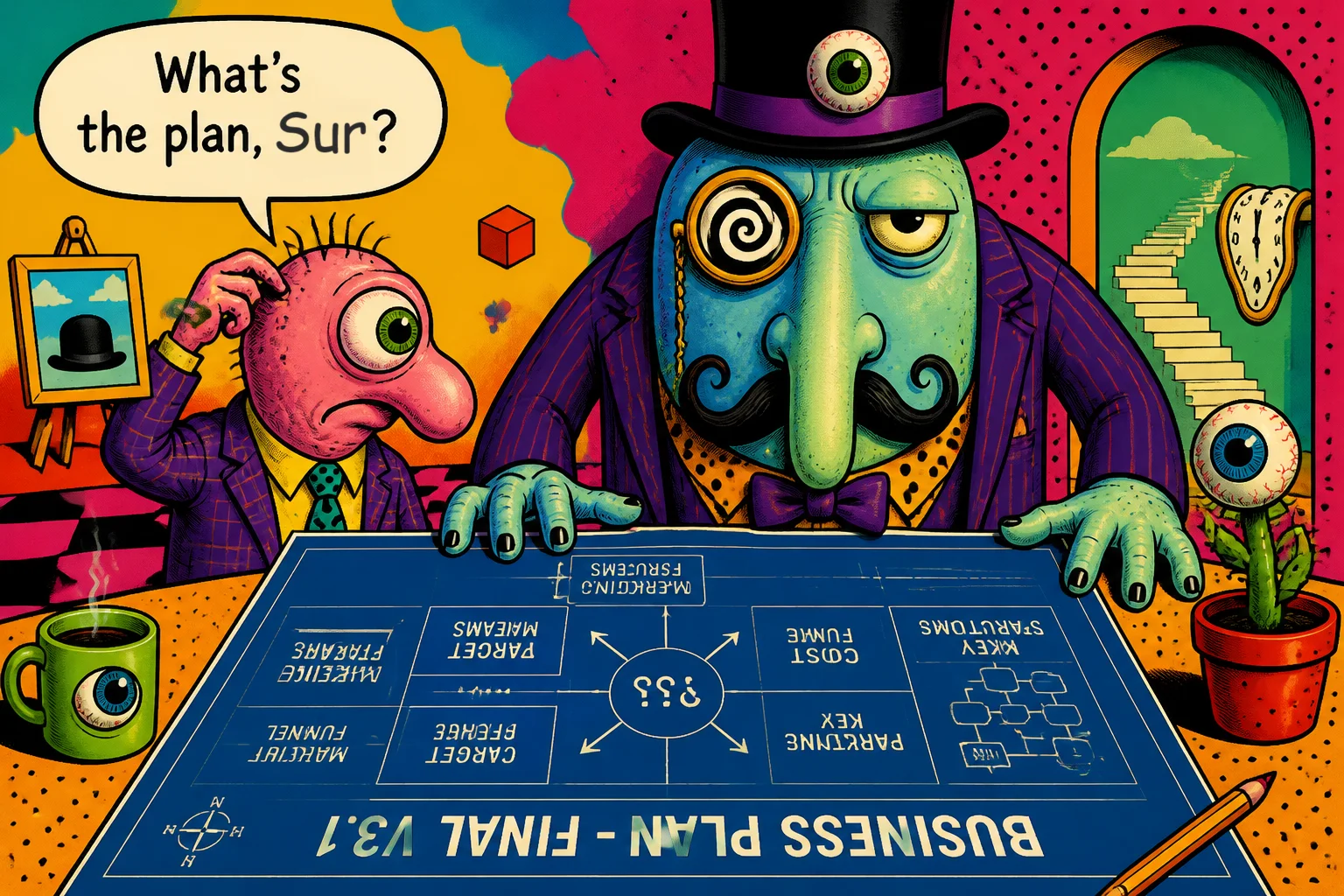
You’ve even got a folder called BUSINESS IDEAS – FINAL VERSION 3.1.
…and still no clue how to start.
Maybe you should
…or try
… or keep scrolling to get
an Insider’s POV:
Every Solopreneur Starts…

…with the same question:
How Can I Make Money Online?
Before you choose a website builder, sign up for a course or
start posting on social media,
answer one important question:
Where will the money actually come from?
A website isn’t a business model.
Neither is social media, email marketing or paid advertising.
These are ways to build, promote or operate a business.
You still need a way to turn what you do into revenue.
Let’s separate the moving parts.
Decision→
Strategy →
Formal plan →
Ongoing business management
So, let’s look at
1. Your Business Model — How You Earn
Your business model describes how the business generates revenue.
You might use one model or combine several as the business grows.
- Affiliate marketing:
Recommend other people’s products or services and earn commissions when referrals generate qualifying sales or actions. - Your own products or services:
Sell something you create, provide or deliver yourself, from digital downloads and software to consulting and physical products. - Ecommerce and dropshipping:
Sell products online. With dropshipping, a supplier typically fulfils orders on your behalf. You earn revenue from sales, but the costs of products, fulfilment, marketing and other expenses determine whether you make a profit. - Advertising revenue:
Earn money by allowing advertisers to place ads alongside your content, videos or other audience-facing material. - Sponsorships and brand partnerships:
Get paid by companies to feature, discuss or promote their products or services. - Memberships and subscriptions:
Charge people for ongoing access to content, tools, a community or a service.
These models aren’t mutually exclusive.
An affiliate website might later add its own digital products,
sponsorships or paid membership.
The point is to understand how the money comes in before deciding what to build around it.
2. Your Traffic and Marketing Channels — How People Find You
Even a brilliant offer won’t earn much if the right people never discover it.
Your channels are the routes through which potential customers find you,
learn about what you offer and decide whether to take action.
These might include:
- Search engines:
Attract people searching for answers, comparisons or solutions. - Social media and online communities:
Build visibility, start conversations and connect with potential customers. - Email marketing:
Build relationships with people who have chosen to hear from you, then guide them towards relevant offers. - Paid advertising:
Pay to put your message in front of a selected audience. - Partnerships and referrals:
Reach new people through other businesses, creators or existing customers.
A channel isn’t a guaranteed source of income.
Its value depends on the audience you reach, what you’re offering and how effectively you connect the two.
Traffic alone doesn’t pay the bills; relevant attention and a workable route to revenue matter.
3. Your Business Infrastructure — What Makes It Work
Once you know how you intend to earn and reach potential customers,
you can work out what you need to operate the business.
Depending on your model, that might include:
- A website, domain and hosting to establish your own online home.
- Email lists and automation to capture leads, communicate with subscribers and follow up without doing everything manually.
- An ecommerce platform and payment system to take orders and process payments.
- Content creation and scheduling tools to produce and distribute your marketing.
- Analytics and business-planning tools to track performance, understand your numbers and make better decisions.
You won’t need every tool on day one.
Your business model determines what you need, and your budget determines what makes sense to start with.
Where Does Affiliate Marketing Fit?
Affiliate marketing is a proven business model built around connecting people with products and services that meet their needs.
You promote a merchant’s products or services, refer potential customers and earn commissions when those referrals meet the programme’s requirements. You don’t need to develop your own products, manage stock or handle fulfilment. Instead, you build an audience, attract targeted traffic, create useful content and connect the right people with relevant offers.
That creates plenty of room to build a real business.
You can focus on a particular niche, develop authority in your subject, grow an audience through organic search, social media and email, and build a portfolio of relevant affiliate partnerships. Over time, your content and audience become valuable business assets that can generate income from multiple offers and traffic sources.
Like any business model, success depends on execution.
Choosing suitable products, understanding your audience, earning trust, developing consistent traffic and managing your costs all matter.
Merchant terms, commission structures and tracking also deserve attention.
The opportunity isn’t simply to earn a commission.
It’s to build an independent online business around useful content, targeted audiences and products people genuinely want.
Start With the Business. Then Build the Plan.
You don’t need to have every detail figured out before you begin.
You do need a reasonable idea of what you’re selling or promoting,
who might want it, how you’ll reach them and
where the revenue is supposed to come from.
That’s what your plan helps you work through.
Use the planning tools below to test your idea,
understand your customers, map out the numbers
and decide what needs to happen next.
You can build the website, choose your tools and learn the skills as your plan takes shape
— rather than collecting a pile of subscriptions and hoping a business appears.
Planning to
Get Down To Business
The distinction between types of plans comes from the job being done,
rather than three increasingly long lists of software features:
| Type | The central question | What you get |
| Early-days planning: Marketing research, strategy & idea validation |
What should I build, for whom, and how will I reach them? | Direction and strategy |
| Business planning and forecasting | Can the numbers work, and what happens if things change? | Financial model and ongoing planning |
| Formal business plan | How do I bring the whole business together in a document? | A structured plan to use or present |
Let’s take a deeper look at each
Marketing research, strategy & idea validation
Have an idea, but need to work out whether it has legs?
Before you build anything, you need to figure out what you’re building,
who it’s for, and why anyone would want it.
This is where market research, idea validation and marketing strategy come in.
And pardon the cliché, but yes — you need to find your niche.
More importantly, you need to understand the people in it,
the problem you’re solving, and how you’ll reach them.
This type of planning helps you make better decisions
before committing too much time or money.
It gives you a clearer direction for your website, products,
content, marketing and eventual sales strategy.
What you’ll work on:
- Market and audience research
- Idea validation and niche selection
- Customer personas and journeys
- Positioning and value proposition
- Brand and marketing strategy
- User acquisition and distribution
- Conversion strategy
- Marketing operations and campaign assets
A Very Useful Tool:
Still figuring out who your business is for, what makes it different and how to reach the right people?
FounderPal helps you work through those questions with AI-guided audience research, market insights and marketing strategy.
There’s a free starting point, so you can explore your idea before committing money to it.
The point:
Work out what you’re trying to build,
who you want to reach,
and how you’re going to get it in front of them.
Business Planning & Financial Forecasting
Know what you want to build — but need to understand whether the numbers work?
A business idea can look brilliant until you start adding up the costs.
Business planning and financial forecasting help you turn your assumptions
into something you can examine, test and adjust.
This is where you map out expected income, expenses, cash flow and profitability.
You can model different scenarios, compare actual performance against your forecasts,
and explore questions such as whether you can afford to hire,
expand, increase your prices or survive a drop in revenue.
Some platforms also combine guided business-plan creation
with ongoing financial management, industry benchmarks, accounting integrations and performance tracking.
That makes them useful beyond the startup stage:
your plan becomes something you can revisit as the business changes, rather than a document you write once and forget.
What you’ll work on:
- Guided business planning
- Financial forecasting and projections
- Profit and loss, cash flow and balance sheets
- Scenario modelling and industry benchmarks
- Performance tracking and actual-versus-forecast comparisons
- Accounting integrations and ongoing business reviews
- Preparing plans for lenders or investors, where supported
A useful Tool:
Need to bring your business idea, strategy, operations and financials together into a structured plan?
LivePlan guides you through building a professional business plan, with market research, financial forecasts and performance tracking tools to help you plan ahead and manage the business as it grows.
The point:
Test whether the business is financially workable,
understand what different choices could mean,
and keep an eye on whether reality matches the plan.
Formal Business Plan Creation
Need to bring the whole business together on paper?
A formal business plan pulls your idea, market, strategy, operations and financial projections into one structured document.
It gives you a coherent picture of how the business is supposed to work
— and something you can present to other people when the situation calls for it.
This can be particularly useful when preparing to approach a lender, investor, partner or other stakeholder.
Some tools help generate the document from guided inputs;
AI-assisted options may also help develop market and competitor research
or identify relevant industry and regulatory considerations.
The important distinction is that creating a business plan isn’t quite the same as managing a business financially.
A generated document can help you organize and communicate your thinking,
but its usefulness depends on the quality of the information behind it.
Don’t mistake a polished-looking plan for proof that the business will succeed.
What you’ll work on:
- Structured business-plan generation
- Executive summary and company description
- Market and competitor analysis
- SWOT analysis and industry trends
- Marketing and operational plans
- Financial projections, profit and loss, cash flow and break-even analysis
- Document editing and presentation
- Market-specific or regulatory research, where supported
A Useful Tool:
BizPlanner helps turn your business assumptions into a plan you can actually examine.
Build out your business model, explore your market and competitors, and generate financial projections covering revenue, costs, cash flow and profitability. It’s a useful way to get the bigger picture on paper before committing your time and money.
The point:
Bring the business into a structured, usable document
— particularly when you need to explain the plan to someone else.
So What’s the Plan, Stan?
Are you testing an idea?
Working out who you’re selling to?
Building a proper business plan?
Trying to understand the numbers before you start spending money?
Planning to scale?
Different problems need different kinds of planning.
So rather than throwing every planning tool into one big pile,
I’ve separated them by the job they actually do.
Which type of Business Plan do you need?
The buttons below lead to Tools designed to help you with the different types and stages of business plans.
The quiz is a free SurvivalIncomeOnline tool, build to help you identify the type of plan you may need.
Some of these buttons are affiliate links. Buy through one and SIO may earn a commission — at no extra cost to you. The seller picks up the tab, not you.
Before You Build
Learn the Business Behind the Business
- Understand the model: What problem are you solving, for whom, and how will the business earn money?
- Check the assumptions: Is there demand? What evidence do you have? What could make the idea fail?
- Learn the numbers: Revenue, expenses, profit, pricing, break-even and cash flow.
- Learn to attract customers: Marketing, sales, audience research and customer retention.
- Choose your tools intelligently: Only after you understand what needs doing and why.
Don’t Just Make a Plan.
Understand It.
You can use AI to help develop a business plan,
work through a planning tool,
or bring in a professional to help you put everything together.
But whichever route you choose, don’t stop at getting a document that looks impressive.
Take the time to understand what it tells you.
What do the numbers actually mean?
How will the business make money?
What assumptions are you making about your customers, costs and potential sales?
What would have to be true for this idea to work — and what happens if it doesn’t?
You don’t need an MBA to start an online business,
and you don’t need to become an expert in every subject before taking your first step.
But learning the basics of business,
marketing, pricing, cash flow
and your chosen business model
can help you ask better questions and make better decisions.
Quiz your Bizz
Identify the type of Business Plan you need
One last thing before you disappear down the rabbit hole…
I know.
Building the website is more fun than planning it.
Trying shiny new tools is more fun than checking the numbers.
And “I’ll figure it out as I go” has a certain rebellious appeal.
But even old mothers know when to nag.
A little planning now can save you from building the wrong thing, spending money in the wrong places, or discovering six months down the line that your brilliant idea has a rather large hole in it.
You don’t need a 90-page business plan before you start.
You do need some idea of what you’re building, who it’s for and where the money is supposed to come from.
Plan → Build → Profit
Do the thinking. Then build the machine.
I promise the tools will still be there when you’re done
That it for planning then???
Have you
Grabbed your Survival Guide, yet?
Inside this free guide, you’ll find
– a compact selection of tools,
– The One-Step Survival Strategy
– and a curated list of resources